
Save for a Brighter Future with RETRO LED Energy Savings
When a theater, auditorium, school, church, or other facility wants to upgrade an existing lighting system, it does not always need to replace the entire fixture. Canto USA’s RETRO Series delivers RETRO LED energy savings by replacing existing lamps while letting many venues keep their current housings, wiring, and dimming infrastructure.
RETRO fixtures are available with standard and custom mounting options and provide 0–100% forward- and reverse-phase dimming for use with a wide range of existing dimming systems.
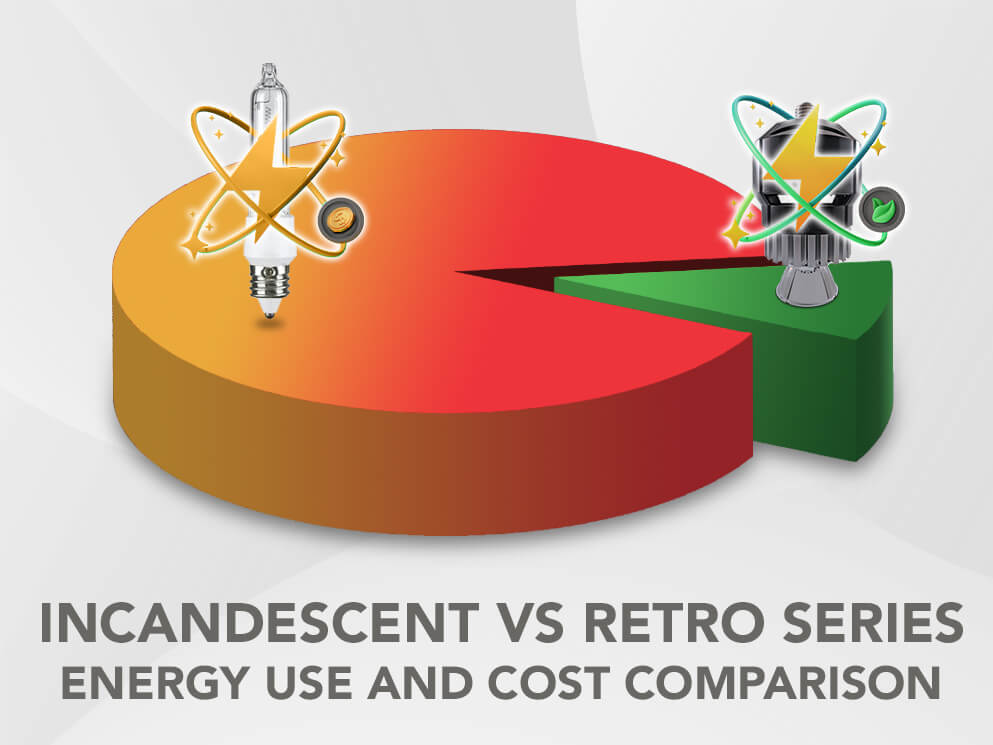
One of the biggest reasons facilities make the switch is energy use. A comparison between a traditional 500-watt incandescent lamp and a RETRO 500 shows how quickly that difference can add up.
500 Watts Compared With 49 Watts
A typical auditorium may use 500-watt incandescent lamps for its house lighting, particularly in spaces with higher ceilings.
The current RETRO-Fusion® 2.0 500 uses a 49-watt load while delivering more light than most 500-watt incandescent lamps it replaces.
That means each fixture can reduce its connected load by approximately 451 watts, or a little over 90%.
Across an entire auditorium, those savings become much more noticeable.
What That Can Mean Over a Year
Richard Schick of Schick Shiner and Associates shared insight from more than 30 years of theater-management experience on how often auditorium houselights are actually used.
“There are institutions that have building management systems that shut everything off late at night. We discourage this as theaters can run 24 hours a day, and the auto-system can shut lights off at inconvenient times, creating an unsafe environment. Most theaters do not have ‘cleaners lights’ so you could have the house lights on 45 to 60 hours a week. We did a study for a theater in Vancouver, BC, where we projected the payback would be 6 months and thereafter reduced hydro bills!”
Using the upper end of that example, consider an auditorium with 20 fixtures operating 60 hours per week.
With twenty 500-watt incandescent lamps, the connected load is 10,000 watts. Twenty 49-watt RETRO 500 units use 980 watts.
That is a reduction of 9,020 watts, or 9.02 kW.
Over 60 hours per week for 52 weeks, the difference comes to approximately:
28,142.4 kWh per year
At an example electricity rate of $0.12 per kWh, that would equal approximately:
$3,377.09 in annual electricity savings
Actual savings will vary depending on operating hours, dimming levels, local utility rates, and how the lighting system is used.

Energy Savings Are Only Part of the Calculation
Electricity use is not the only expense involved with traditional high-wattage house lighting.
Facilities may also need to account for:
- Replacement lamps
- Maintenance labor
- Lift or scaffolding rental
- Difficult-to-access fixtures
- Facility downtime during maintenance
- Cooling costs associated with the heat produced by incandescent lamps
LED fixtures produce substantially less heat than comparable high-wattage incandescent lamps, which can reduce the heat added to the room.
Installation requirements depend on the existing fixture and electrical system, but the RETRO Series is designed specifically to simplify conversion by reusing compatible existing infrastructure wherever possible. Canto currently describes the RETRO-Fusion 2.0 as a direct replacement for existing lamps with options for recessed, pendant, and custom installations.
How to Estimate Savings and Simple Payback
Use the example numbers above to estimate savings for your facility: calculate the per-fixture wattage reduction (451 W in the example), multiply by the number of fixtures to find kW saved, then multiply by weekly operating hours and 52 weeks to get annual kWh saved. Multiply annual kWh saved by your local electricity rate to estimate annual electricity cost savings. This post uses $0.12/kWh as an illustrative rate; substitute your actual utility rate for a site-specific estimate.
Because installation costs and any required modifications vary by site, a simple payback period cannot be calculated without project-specific retrofit costs. The study referenced by Richard Schick projected a 6-month payback for that particular venue; your results will depend on fixture counts, operating hours, and installed costs. For project-specific estimates and spec sheets, contact Canto USA or review our documented installs and customization guidance below.
See a measured long-term result in our Fairfax High School case study, The RETRO — 3 Years Later: Fairfax High School RETRO Series LED retrofit, which documents connected-load reductions after installation. For guidance on fitting RETRO units to unusual housings, consult RETRO Series Customizations: Fit the RETRO to Your Fixtures.
More Than Lower Power Consumption
For facilities still using high-wattage incandescent house lights, the energy difference alone can make an LED retrofit worth evaluating.
Moving from 500 watts to 49 watts per fixture can reduce the lighting load by more than 90% while also providing modern dimming performance and reducing routine lamp maintenance. Canto USA has documented similar reductions in real installations, including Fairfax High School, where 105 500-watt lamps were replaced with RETRO 500 units, and the total connected load dropped from 52,500 watts to 5,145 watts.
For theaters, auditoriums, schools, churches, and other facilities looking to modernize their house lighting without replacing an entire system, the RETRO Series provides a way to reduce energy use while working with much of the infrastructure already in place. Contact Canto USA for project planning, spec sheets, and site-specific guidance.

Canto USA’s RETRO Series Fully Dimmable LED Retrofit Houselights
Canto USA is proud to present our RETRO series. The RETRO-Fusion® 2.0 and RETRO-Passive® 2.0 are 0-100% phase dimmable (forward and reverse) variable wattage LED 2700K-6500K 80-97 CRI engines. They are designed for older SCR, TRIAC, and IGBT dimmer systems but are compatible with newer dimmer systems. A direct replacement of existing lamps, our LED retrofit can be used in a wide range of applications or even new installations. Custom and standard mounting options are available.


